

Multi-model is the default.
Product teams route across providers for quality, cost, and latency. Single-provider assumptions no longer hold.
MVP AI infrastructure LLM gateway
Multi-provider inference without the integration sprawl: deterministic tests, policy-aware routing, and one request trail.
THE OPPORTUNITY
Provider integrations differ in request formats, credentials, failure behavior, and operational details. Teams must absorb those differences while deciding how retries, fallback, usage, quotas, and access rules should work.
Testing against live services requires provider keys, depends on external availability, and incurs usage charges. Without deterministic fixtures and a clear request trail, failures are hard to reproduce and spend is hard to explain.
Product teams route across providers for quality, cost, and latency. Single-provider assumptions no longer hold.
Usage, quotas, and chargeback need enforcement before the request, not a dashboard after it.
Models, formats, limits, and terms change. The integration layer has to absorb the change.
Initial buyer hypothesis. Platform and API teams at AI product companies and studios running multiple providers. The economic buyer is the engineering leader accountable for inference spend and reliability.
THE PRODUCT
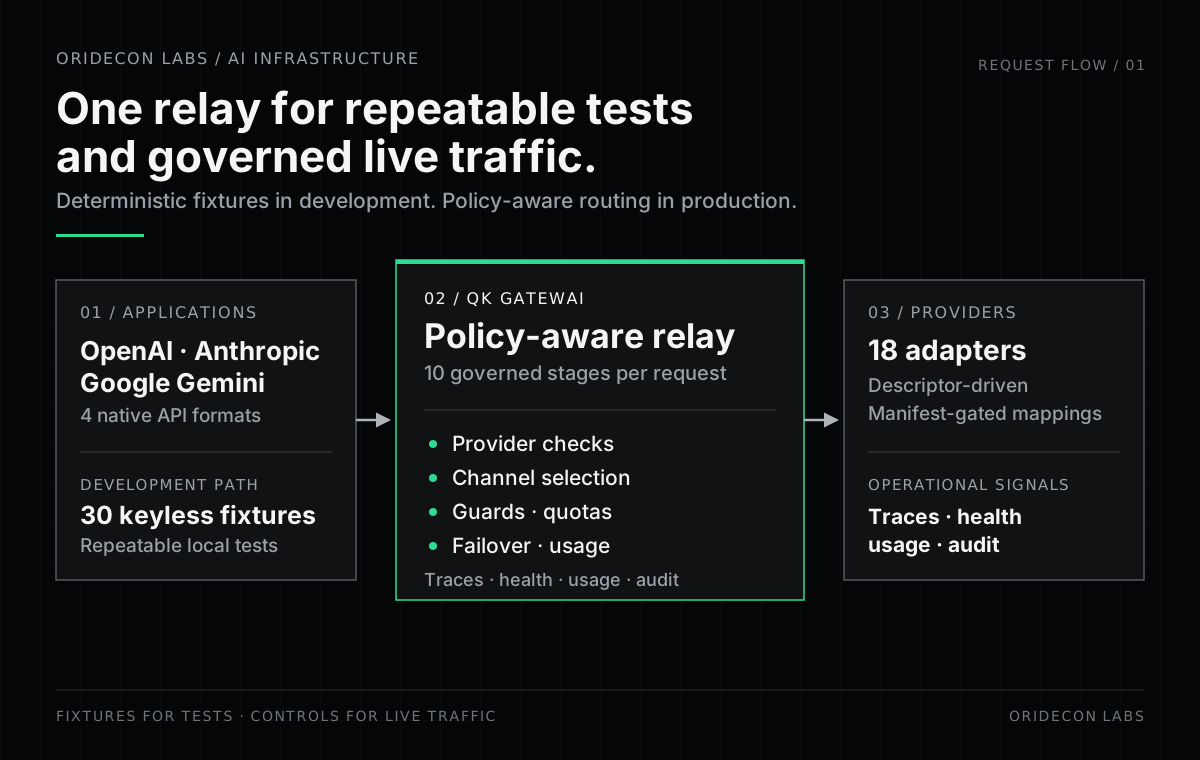
Gatewai combines deterministic keyless fixtures for development with a live relay that checks provider mappings, applies routing and policy, records usage, and leaves an audit trail.
The descriptor catalogue represents 18 provider adapters and accepts OpenAI Chat, OpenAI Responses, Anthropic Claude, and Google Gemini request formats. This is catalog scope, not a claim that every provider has been live-qualified; broader compatibility validation remains in progress.
A 10-stage pipeline supports policy-aware channel selection, guards, fail-closed provider checks, usage and quota controls, and request tracing.
Workspace access controls, audit history, and operator surfaces make provider activity and governance easier to inspect.
Thirty deterministic, keyless fixtures support repeatable development and tests. The offline path covers a stub-provider request, an OpenAI-shaped response, usage recording, and the settled request-log entry.
Developer entry point: the QK Gatewai Community Edition packages the zero-credential local path for individual developers.
PRODUCT SURFACE
Explore the dashboard, connectivity, offline samples, and governance surfaces. Open any image to browse the full set of 25 captured console screens in the lightbox.
EVIDENCE & ROADMAP
Billing and plan-management components exist internally, but resale is off by default and some subscription flows remain incomplete. The commercial offer is not generally available.
Internal dogfooding, not external traction. Novelino routes its model and media calls through Gatewai. No external customer adoption, revenue, or measured impact is claimed.
COMMERCIAL THESIS
The wedge is developer experience: compatible APIs and deterministic fixtures. The expansion is operational control: routing policy, quotas, audit, and workspaces. Monetization follows usage and assurance.
Developers connect through familiar request formats and can test without a provider key; the gateway absorbs provider-specific differences.
Routing policy, guards, workspaces, quotas, traces, and audit build on the same relay as teams add providers and use cases.
Planned directions: usage-based text and media markup, team subscriptions, prepaid credits, self-serve access, and dedicated enterprise gateways.
| Category | Typical strength | What it leaves open |
|---|---|---|
| Single-provider SDKs | Fastest path to one provider | Per-app integration; no central governance or request trail |
| Routing proxies | Multi-provider routing and fallback | Test determinism, policy depth, and audit are separate concerns |
| Observability tools | Traces, cost visibility, and evaluation | Visibility without enforcement or routing |
| Cloud and edge gateways | Scale, security, and network integration | Provider-specific semantics and keyless development fixtures |
| Gatewai | Deterministic fixtures plus policy, usage, and audit in one self-hostable relay | Live-provider qualification and commercial packaging are in progress |
THE ASK
Seeking a milestone-based pre-seed partnership. Raise amount, runway, and allocation are in the funder brief.
Close live-provider gaps, publish a repeatable provider benchmark, and finish a security review.
Convert Novelino into a measured case study and test pricing with external teams.
Enable usage settlement, signup, and API-key provisioning; publish the first external usage report.
Use of capital. Engineering, design-partner onboarding, security and compliance, and go-to-market. Raise amount, runway, and detailed allocation are in the funder brief.
TEAM & RISKS
FOUNDER-LED EXECUTION
Product direction, architecture, and delivery stay with the founder and technical lead. QuadKit was built without external funding; funders work directly with the person accountable for execution.
QuadKit supplies reusable foundations; coding agents extend implementation capacity; the founder reviews architecture, tests, and acceptance. Capital goes to product milestones, not rebuilding the platform.