



Scope around your workflow
Your team brings the domain context. Together we define the users, constraints, and first testable milestone; a technical lead turns that into architecture and acceptance criteria.
ORIDECON LABS · AI PRODUCT ENGINEERING
Turn your AI idea into a product designed around your business—with hands-on technical leadership, an open-source QuadKit foundation, and coding agents.
In-house reusable packages · Human-led engineering · Agent-augmented implementation
FROM WORKFLOW TO WORKING PRODUCT
HOW WE WORK
Your team brings the domain context. We bring technical ownership, in-house QuadKit packages, and coding agents used in bounded, reviewed tasks.
Your team brings the domain context. Together we define the users, constraints, and first testable milestone; a technical lead turns that into architecture and acceptance criteria.
Coding agents take bounded implementation tasks against shared interfaces. A technical lead integrates and reviews the work so decisions, tests, and acceptance criteria stay coherent.
Our in-house, open-source QuadKit packages provide shared project structure and common foundations. They reduce repeated setup, leaving engineering attention for your domain rules, integrations, safeguards, and operator experience.
SELECTED WORK
Explore the context, product response, and engineering behind each MVP. Build-scope figures describe what was implemented—not customer adoption or measured outcomes.
Teams integrating AI providers have to account for different request formats, credentials, failures, and usage behavior. Testing against live services can also require provider keys and incur usage charges, while runtime health and request history need to be inspected separately.
QK Gatewai gives developers repeatable, keyless fixtures for local tests and a governed relay for live provider requests. Provider checks, routing and fallback, guards, quotas, traces, health, and audit provide AI observability from development through operations.
Descriptor-driven dispatch covers 18 catalogued provider adapters and four API formats through a 10-stage relay. The count describes adapter catalogue scope; live-provider compatibility is still being qualified. Manifest-gated provider entries and fail-closed checks catch missing mappings. Thirty deterministic, keyless fixtures support repeatable development and tests; the offline path exercises a stub-provider request through response, usage, and request-log settlement. Channel health, task monitoring, traces, usage/quota controls, and audit surfaces expose runtime behavior. Novelino routes model and media calls through Gatewai.
Screen adaptations coordinate scripts, approved story facts, characters, scenes, visual assets, voices, and music. Disconnected AI outputs can drift from the creator’s canon while production work scatters across tools.
Start from a brief, guided interview, or manuscript. Novelino proposes story facts for creator approval, then supports episode and beat scripts, storyboards, images, video, voice, and music. Creators keep final say and can track continuity and release progress.
Only source-linked facts the creator approves enter the rebuildable Series Canon Knowledge Graph; AI never approves them automatically. Episode plans bind the prompt, source, and continuity hashes, then check provider readiness before charging. Background workers track script and media jobs; the Studio Cockpit shows stage coverage, missing assets, failures, and release readiness. Five modalities use Gatewai’s 18+ configured adapters without vendor SDKs embedded in the app; live-provider qualification is ongoing.
Pet owners searching symptoms encounter conflicting advice, while urgency and next steps depend on the pet’s details and how symptoms change over time.
Piccolina’s AI-assisted wellness check combines symptom reports with species, breed, age, and health-history context. It can ask targeted follow-up questions and return source-linked possible explanations, urgency cues, monitoring and escalation guidance. Follow-up checks can assess reported changes; local clinic discovery helps owners explore next steps.
The five-stage analysis orchestration guards intake and checks deterministic emergency red flags before model inference. It brings together pet and breed context with parallel symptom, breed, and urgency/first-aid retrieval, then sends the assembled prompt—and supported photos—through the inference router. The response is parsed and schema-validated into ranked possible explanations, urgency, care guidance, and escalation triggers, with citations from retrieved sources. Follow-up checks reuse the prior analysis thread to assess reported changes and escalation.
Piccolina provides informational guidance only—not a veterinary diagnosis or substitute for care from a licensed veterinarian. Seek urgent veterinary care for emergencies.
THE FOUNDATION
QuadKit is a reusable, open-source Python foundation. Two entry points, one destination: a real project the team can build on — and a coding agent can operate.
One command writes the canonical project tree — and the operating manual a coding agent already knows how to read.

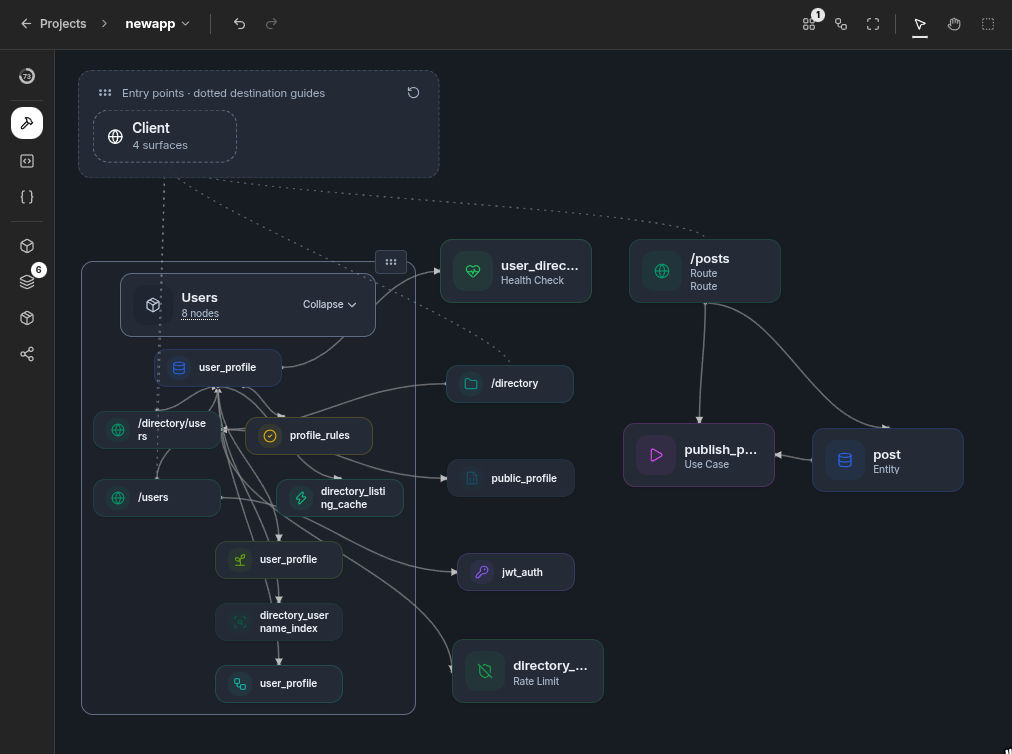
Wire domains, providers, and modules as a graph, then export a structured starter. The structure is decided up front — your agent spends its tokens on the product, not the scaffold.
THE NOTES
Releases, product plans, and framework internals — what the studio is building, in the open.
A CLEAR FIRST STEP
Tell us who the product is for, what is difficult today, and what a useful first milestone would look like.